Imagine waking up, making coffee, and opening your laptop to find that you earned money while you slept.
- No warehouse to manage.
- No customer service queues to wade through.
- No product to invent.
Just commissions landing in your account because people bought products you recommended, products someone else created, fulfils, and supports.
Artificial intelligence has compressed the learning curve that once separated from seasoned marketers.
This guide exists to give you the full picture.
Whether you are starting with zero money and zero experience, or you already have a website and want to monetise it more effectively, every section ahead is written for you.
Read it end to end, bookmark it, and then, most importantly, do the work. Because the only thing standing between you and your first affiliate commission is taking action.
What Affiliate Marketing Actually Is
Here is the basic flow of affiliate marketing broken down into four steps:
A person searches for information or a product online.
They find your content, a blog post, a YouTube video, a social media post.
- They click your affiliate link and visit the seller’s website.
- They make a purchase, and you earn a commission.
Sometimes you earn a commission even if they just sign up for a free trial.
That’s it. The seller tracks everything through your unique affiliate link, which contains a special code that identifies you as the referrer.
Most affiliate programs use cookies that can track a visitor for 30 to 90 days, meaning even if someone clicks your link today and buys tomorrow, you still get credit for the sale

Affiliate marketing has been around since the late 1990s, but the landscape has changed dramatically.
Here is what is different today:
- Tools like ChatGPT, Claude, and Gemini can now write blog post drafts, research keywords, generate video scripts, and even respond to emails. What used to take a team of writers can now be done by one person with the right AI workflow.High-ticket is the new normal.
- Experienced affiliates are moving away from $10 products with tiny commissions and focusing instead on high-ticket items, software subscriptions, online courses, financial products, where a single sale can earn $200 to $2,000 in commission.
- Short-form video is exploding. TikTok, Instagram Reels, and YouTube Shorts have created new channels for affiliate marketers to reach millions of people without a big audience or advertising budget.
- Email marketing is very valuable. Despite what you may have heard about “email being dead,” the marketers who build email lists in 2026 have a direct line to their audience that no algorithm can take away.
Understanding who is involved helps you see where you fit in the picture:
- The Merchant (also called the Advertiser or Brand): This is the company or person that creates and sells the product. Amazon, Shopify, GoHighLevel, Bluehost — these are all merchants with affiliate programs.
- The Affiliate Network: This is a middleman platform (like Clickbank, ShareASale, or Impact) that connects merchants with affiliates, tracks sales, and handles commission payments.
- The Affiliate (that’s you): You are the publisher. You create content that promotes the merchant’s products and earn a commission for every sale you drive.
- The Customer: The person who clicks your link and makes a purchase. They usually do not know (and often do not care) that you earn a commission. Your job is simply to connect them with the right solution to their problem.
Phase 1: Choosing a Profitable Niche
If there is one decision that will define your affiliate marketing success more than any other, it is your niche selection.
Get this right and everything else becomes easier. Get it wrong and you could spend months creating content that never earns a dollar.
A niche is simply a specific topic or market segment you are going to focus on. Instead of “health,” your niche might be “keto diet for women over 40.” Instead of “technology,” your niche might be “best project management software for small teams.”
The more specific you are, the easier it is to rank on search engines and connect with an audience that is ready to buy.
The Three elements of a Good Niche
A profitable niche needs to tick three boxes:
- There are people actively searching for it. This is called search demand. If nobody is Googling your topic, nobody is going to find your content no matter how good it is.
- Those people are willing to spend money. Some niches have high traffic but low buyer intent. You want a niche where people are looking to buy something, not just looking for free information.
- There are affiliate products available to promote. Before choosing a niche, spend 15 minutes searching for affiliate programs in that space. If you can’t find any good products to promote, move on.
One of the biggest mistakes beginners make is promoting cheap products. Here is a quick math lesson that will change how you think about this:
To earn $3,000 per month promoting a product that pays $3 per sale, you need 1,000 sales every month. That is a massive amount of traffic and conversions. But to earn $3,000 per month promoting a product that pays $300 per sale, you only need 10 sales. Ten sales a month is achievable even for a brand-new website.
This is why high-ticket affiliate marketing has become so popular. Focus on niches where products cost $500 to $5,000 and offer commissions of 20 to 50 percent. Software products (also called SaaS) are especially attractive because they often pay recurring commissions meaning you get paid every month as long as your referred customer keeps their subscription active.
How to find your niche
You do not need expensive software to find a great niche.
Here is a simple process you can follow today:
- Start with your interests. What topics do you already know something about, or are genuinely curious to learn? Passion is not everything, but it helps enormously when you are writing your 50th blog post.
- Check Google Trends. Visit trends.google.com and search for your topic ideas. You want to see stable or growing interest over the past five years, not a declining trend.Use a free keyword tool.
- Tools like Ubersuggest (free tier) or Google’s Keyword Planner can show you how many people search for a topic each month and how competitive it is.
- Search for affiliate programs. Type your niche plus ‘affiliate program’ into Google. For example: ‘best project management software affiliate program.’ Browse the results to see what commissions are available.Check Clickbank and Amazon. Both platforms show you what is already selling well in different categories. High sales numbers confirm buyer demand.
Evergreen niches are topics that people will always care about, regardless of what year it is. Personal finance, weight loss, relationships, parenting, pet care, and technology are all examples. These niches provide long-term stability because the demand never disappears.
Trending niches are topics that are hot right now but may cool off. Cryptocurrency strategies, AI tools reviews, and social media platforms can all be extremely profitable in the short term but carry more risk.
For beginners, we recommend starting with an evergreen niche that has strong affiliate products available. Once you understand how the business works and start generating consistent income, you can explore trending opportunities as a supplement.
Phase 2: Building your digital platform
Once you have chosen your niche, you need a place to publish your content and house your affiliate links.
Think of this as your online headquarters. Everything you do, your blog posts, your videos, your email list — will drive traffic back to this home base.
Choosing the Right Platform
WordPress houses over 40 percent of all websites on the internet. It is the most recommended platform for affiliate marketers because it gives you complete control over your content, your SEO settings, and your design.
It is also the most scalable option — many six and seven-figure affiliate sites are built on WordPress.The slight downside is that WordPress has a small learning curve.
You will need to purchase web hosting separately (more on that below), install WordPress on your host, and then install a theme and some basic plugins. This might sound technical, but with modern hosting providers, the whole process takes about 30 minutes and many hosts provide one-click WordPress installation.
If your website is a house, web hosting is the land it sits on. Every website needs hosting servers that store your files and make them accessible to visitors. For WordPress sites, you will need to purchase hosting from a provider like Hostinger, Bluehost, or SiteGround.
Quick Tip: When you sign up for hosting, you will also register your domain name (your website’s address, like yoursite.com). Choose something simple, memorable, and related to your niche. Avoid hyphens or numbers if possible
So if you’re ready to start your website,
This is a very straightforward process especially when using Hostinger. You get your hosting plan for $33.51 per year using my 20% discount link. You’ll also be able to host 3 different websites. You’ll also get a domain name for free for the first year
Once you sign up, go over to the websites tab and you’ll find your website list, and you’ll be able to login to your wordpress dashboard from here.
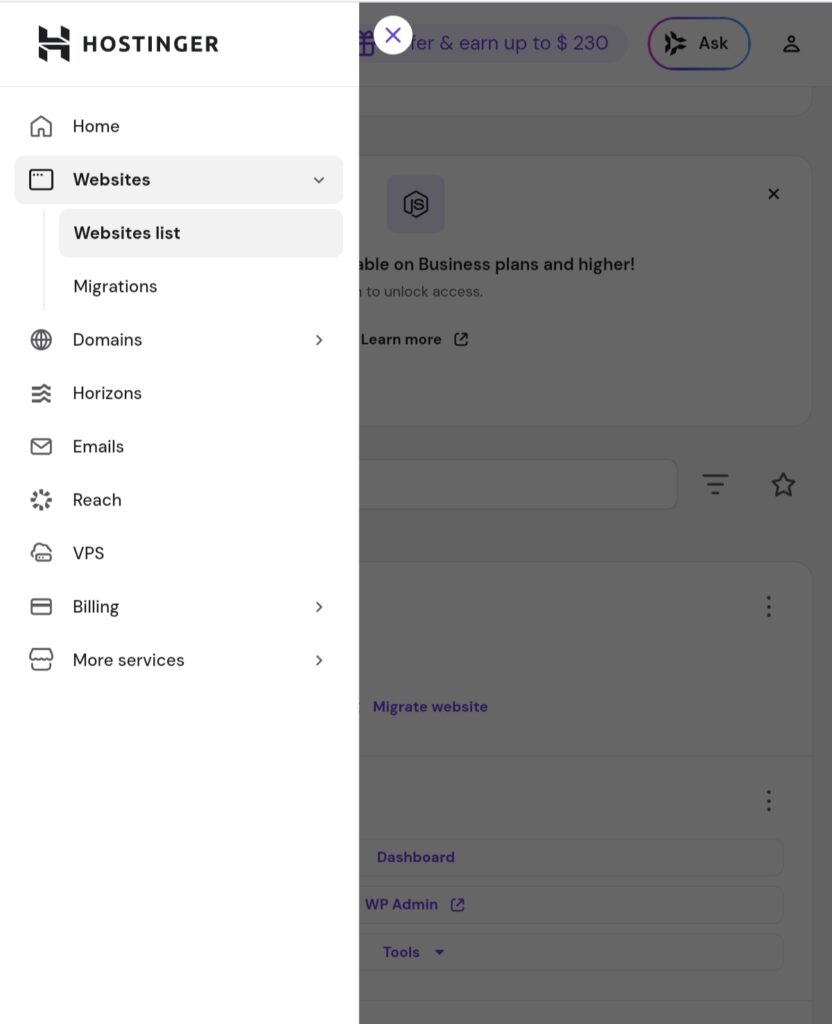
On WordPress, you’ll be able to add content to your blog.
For beginners, Hostinger is frequently recommended because it offers fast loading speeds at very affordable prices often under $3 per month on introductory plans.
Speed matters because Google uses page load time as a ranking factor, and slow sites lose visitors fast.
Here is the basic flow to get your site live:
- Sign up for a hosting plan and register your domain name.
- Use the one-click WordPress installer provided by your host.
- Log in to your WordPress dashboard.Install a free theme (Astra, GeneratePress, and Kadence are all excellent, fast, and free).
- Install essential plugins: Rank Math or Yoast for SEO, WP Rocket or LiteSpeed Cache for speed, and Pretty Links for managing your affiliate links.
- Design your core pages: Home, About, Contact, and a Privacy Policy (required by most affiliate programs).Start publishing content.
- Start publishing content
Phase 3: Finding and Joining Affiliate Programs
Now comes one of the most exciting parts: finding products to promote and signing up for affiliate programs.
This is where you start building the revenue side of your business.
Affiliate Networks
There are two ways to find affiliate products: through affiliate networks and through direct partnerships with brands.Affiliate networks are platforms that aggregate thousands of affiliate programs in one place.
You sign up once and then browse hundreds of products across different categories. Popular networks include:
- Clickbank: Focuses heavily on digital products — online courses, software, e-books, and subscription services. Commission rates are often 50 percent or higher, and payouts are reliable. Great for beginners because approval is easy.
- Amazon Associates: Amazon’s affiliate program gives you access to millions of products across every imaginable category. Commission rates are lower (typically 1 to 10 percent), but the conversion rate is high because everyone trusts Amazon.
- ShareASale and Impact: Both are large networks with a mix of physical and digital products. You will find programs from well-known brands including retail stores, software companies, and financial services.
- CJ Affiliate (formerly Commission Junction): One of the oldest and most established networks. Home to many big-brand programs in retail, travel, and finance.Direct affiliate programs are offered by companies outside of networks.
Direct programs
For direct programs, many software companies, hosting providers, and course programs run their own affiliate programs.
To find these, simply Google the name of a product you want to promote followed by ‘affiliate program.’ For example: ‘Shopify affiliate program’ or ‘ConvertKit affiliate program.’
Software as a Service (SaaS) products are especially attractive for affiliate marketers because they typically offer recurring commissions.
Instead of a one-time payment, you earn a percentage of the customer’s monthly fee for as long as they remain a subscriber.
Imagine you refer 50 customers to a $97-per-month software tool that pays a 30 percent recurring commission. That is $1,455 every single month from those 50 referrals — and it keeps coming in as long as they stay subscribed.
Over time, these recurring commissions compound into a very stable income stream.
Some high-ticket SaaS programs worth exploring:
- GoHighLevel (GHL): An all-in-one marketing platform for agencies and small businesses. The affiliate program pays substantial recurring commissions and even offers sub-affiliate income. Very popular in the B2B marketing space.
- ClickFunnels: A funnel-building platform with strong brand recognition. Their affiliate program has created many six-figure earners.
- Convertkit / Beehiiv (email marketing platforms): Email tool affiliates tend to have very sticky customers — people who switch email platforms rarely, meaning your recurring commissions last for years.
Before you sign up and start promoting, evaluate each program on these criteria:
- Commission rate: Higher is better, but also consider the product price. A 5 percent commission on a $2,000 product ($100) beats a 50 percent commission on a $10 product ($5).
- Cookie duration: How long after clicking your link does the customer have to buy before you lose credit? 30-day cookies are standard; 90-day or lifetime cookies are great.
- Payment reliability: Research the company. Do they have a reputation for paying affiliates on time? Read reviews from other affiliates before committing.
- Product quality: This matters more than people think. If you promote bad products, your audience will lose trust in you. Always test or thoroughly research any product you recommend.
- Support and resources: Good affiliate programs provide promotional materials, training, and a dedicated affiliate manager. These resources make your job much easier.
Quick Tip: Start with two or three affiliate programs maximum. Learn them well, understand the products deeply, and promote them consistently. Adding more programs before mastering the first ones is a common beginner mistake.
Phase 4: Content That Sells
Content is the engine of your affiliate marketing business. It is how you attract visitors, build trust, and guide people toward clicking your affiliate links.
In 2026, you have more tools available to create great content faster than ever before.
The Types of Content That Drive Affiliate Sales
Not all content serves the same purpose in affiliate marketing. The highest-converting content types include:
- Product Reviews: A detailed, honest review of a specific product. These convert extremely well because the person reading them is already close to making a purchase decision. Include both pros and cons — overly positive reviews come across as fake and destroy trust.
- Best-of Lists / Roundups: Articles like “Best Email Marketing Tools for Small Businesses in 2026.” These capture people early in their research phase and expose them to multiple affiliate products at once.
- Comparison Articles: Head-to-head comparisons like “ClickFunnels vs GoHighLevel: Which is Better for Your Business?” These get clicks from people who are actively deciding between two options — extremely high buying intent.
- How-To Guides: Tutorial content that solves a specific problem and naturally integrates affiliate tools. For example: “How to Start a Podcast in 2026” can include affiliate links for podcast hosting, microphones, and editing software.
- Case Studies: Showing real results from using a product is incredibly persuasive. If you actually use the tools you promote, document your experience and share it.

Blogging and pinterest:
Done right, pinterest can bring you free, consistent, targeted traffic for months and years without any ongoing cost.
Pinterest is a search engine.
Every piece of content you create should target a specific keyword or search phrase. A keyword is simply what someone types into a search engine. Your job is to find keywords that:
- Have enough monthly searches to be worth your time (at least a few hundred per month for smaller niches)
- Show commercial or informational intent related to what you are promoting
- Are not so competitive that a new website cannot rank for them on pinterest
- Commercial intent keywords are phrases that suggest someone is ready to buy or seriously researching a purchase. Examples include: ‘best kitchen gadgets,’ These are the nice keywords for affiliate marketing because the searcher is already in buying mode.
Free tools for keyword research:
- Google’s autocomplete feature (just start typing in the search bar and see what Google suggests),
- Google Keyword Planner (free with a Google account),
- Ubersuggest free tier,
- and AnswerThePublic (great for finding question-based keywords).
Writing Content That Ranks and Converts
There is a formula to writing great affiliate content that Google loves and readers trust. Here it is:
- Start with the reader’s problem. What question are they trying to answer? What frustration brought them to this search? Open your article by acknowledging that problem.
- Deliver clear, useful information. Google’s algorithm increasingly rewards content that actually helps people. Shallow ‘thin’ content that barely covers a topic will not rank well.
- Be honest about affiliate recommendations. Disclose that you earn a commission (this is legally required in most countries) and only recommend products you genuinely believe in.
- Use a clear call to action. After your recommendation, tell the reader what to do next. Something like: ‘Click here to try [Product Name] free for 14 days.’Optimize your technical SEO.
- Include your target keyword in your title, your first paragraph, and a few times throughout the article. Add descriptive image alt text. Ensure your page loads quickly.
Using Ai to write
This is where 2026 is genuinely different from any previous era of affiliate marketing.
AI writing tools can now produce solid first drafts in minutes, research topics comprehensively, suggest headline variations, and even analyze your existing content to suggest improvements.
Here is a recommended workflow for AI-assisted blog post creation:
- Research first: Ask your AI tool to summarize the top 10 things people want to know about your topic. Use this to outline your article.
- Generate a draft: Give the AI your outline, your target keyword, and your tone of voice preferences. Ask for a comprehensive draft.
- Edit aggressively: AI drafts are a starting point, not a finished product. Add personal experience, specific data points, and your own voice. Google can identify generic AI content, and so can readers.
- Add human expertise: The things that make content truly valuable — first-hand product testing, personal stories, specific industry knowledge — cannot be replicated by AI. This is your competitive advantage.
Quick Tip: Think of AI as your first draft writer and research assistant, not your content creator. The human layer you add on top is what makes your content stand out.
Video Content:
Video is the fastest-growing content format in affiliate marketing, and for good reason. People trust what they can see and hear far more than what they read. A product review video that shows the actual interface, the actual results, and the reviewer’s genuine reaction converts at rates that blog posts struggle to match.
YouTube:
YouTube is the second largest search engine in the world after Google. Building a YouTube channel around your niche allows you to rank for video searches and capture an audience that prefers watching over reading.
The advantage of YouTube is that older videos can keep generating views for years — it is as evergreen as blogging.You do not need a professional camera setup to start. Modern smartphone cameras are more than sufficient for most content.
What matters far more than production quality is the value of the information you deliver.If appearing on camera makes you uncomfortable, there is good news: faceless YouTube channels are thriving. Using screen recordings, stock footage, and AI voiceover tools, many creators produce high-quality educational videos without ever showing their face.
Short-Form Video:
TikTok, Instagram Reels, and YouTube ShortsShort-form video platforms offer the fastest path to an audience for new creators. Unlike SEO, which can take months to show results, a single well-made TikTok or Reel can reach thousands of people the day you post it.
The format rewards authenticity, entertainment, and clear value delivery in under 60 seconds.The challenge with short-form video is that affiliate links cannot be placed directly in most video posts. Your strategy is to drive viewers to a link in your bio (a simple page with all your affiliate links), your blog, or your YouTube channel where longer content and direct affiliate links live.
Email Marketing:
Ask any successful affiliate marketer what their single most valuable business asset is, and the vast majority will say the same thing: their email list. Here is why.Social media platforms can change their algorithms overnight.
A Google update can tank your traffic in 24 hours. But your email list is yours. The 5,000 people who have subscribed to receive your updates cannot be taken away from you by a platform update or a banned account.
You can email them whenever you want, promote whatever products you want, and build a relationship over time that pays dividends for years.
Building an email list starts with a simple offer: give visitors something valuable for free in exchange for their email address.
This is called a lead magnet. It could be a free checklist, a mini e-book, a short email course, a template, or a resource guide — anything that solves a problem for your ideal reader.
Email marketing platforms like ConvertKit, Beehiiv, Mailchimp (free tier), and ActiveCampaign make it simple to create sign-up forms, deliver your lead magnet automatically, and send email sequences.
A good email sequence for affiliate marketing might look like this: deliver value for the first three or four emails, introduce your recommended product in email five, and then continue alternating between value and promotional content.
Paid Traffic:
Paid traffic is fast but costs money and requires more skill to use profitably. As a beginner, we recommend focusing on organic traffic first and only exploring paid traffic once you have a proven offer and some affiliate commissions coming in.That said, here is a brief overview of the paid traffic options available:
- Google Ads: Pay-per-click (PPC) advertising that puts your content or offer at the top of Google search results for specific keywords. Requires careful budget management to avoid spending more than you earn.
- Facebook and Instagram Ads: Best for reaching people based on interests and demographics rather than search intent. Works well for building your email list, promoting free content, and retargeting people who have already visited your site.
- Pinterest Ads: Less competitive and often cheaper than Google or Facebook. Great for visually appealing niches where organic Pinterest is already working for you.
Conclusion
Getting to your first $1,000 per month in affiliate income is about learning the basics. Getting to $10,000 and beyond is about systems, automation, and leveraging what is already working. Let us talk about the strategies that separate intermediate affiliates from the top earners.
Building Systems and Automation
At the beginning, you do everything yourself. You write the articles, post on social media, respond to emails, and track your numbers.
This is fine as a starting point, but to scale, you need to start replacing yourself in tasks that do not require your unique skills and judgment.The first things to automate or outsource:
- Social media scheduling: Tools like Buffer, Later, or Tailwind can automatically post your content at optimal times without you logging in manually.
- Email sequences: Set up a series of automatic emails that go out to new subscribers over days or weeks. Once written, this sequence runs 24/7 without any ongoing effort from you.
- Content production: Once you have a proven content formula, you can hire a writer or virtual assistant to produce first drafts that you then review and edit. Platforms like Upwork and Fiverr have many skilled freelancers who specialize in affiliate content.
Ai Funnels:
The most sophisticated affiliate marketers in 2026 are building Ai funnels rather than relying solely on traditional static websites.
Here is what this looks like in practice:Instead of a blog post that passively sits on your website, an AI funnel can interact with visitors in real time.
Tools that enable this include conversational landing pages, AI chatbots integrated into product review sites, and dynamic email personalization that changes the recommended product based on how the subscriber has previously interacted with your content.
This is an advanced strategy, and you should not worry about implementing it until you have the basics generating consistent income.
But it is good to know where the industry is heading.
Diversifying Your Traffic and Income Sources
One of the biggest risks in affiliate marketing is over-dependence on a single traffic source or a single affiliate program.
Here is why diversification matters:If 100 percent of your traffic comes from Google and an algorithm update negatively affects your site, your income could drop significantly overnight.
If your primary affiliate program shuts down or dramatically cuts commissions (Amazon Associates has done this multiple times), your revenue can disappear with almost no warning.The solution is to build multiple traffic sources in parallel and promote products from multiple affiliate programs.
A well-rounded affiliate business in 2026 might look like this:
- 60 percent of traffic from blogging and pinterest (blog content)
- 20 percent from email list
- 10 percent from YouTube
- 10 percent from social media
- And income spread across three to five affiliate programs, with no single program representing more than 50 percent of total revenue.
Tracking, Analytics, and Continuous Improvement
What gets measured gets improved. Once you are generating traffic and commissions, set aside time each week to review your analytics:
- Which pages or videos are generating the most affiliate clicks?
- Which affiliate programs are converting best?
- Which traffic sources are growing fastest?
- What is your email list growth rate?Google Analytics (free) gives you detailed traffic data.
Most affiliate networks have built-in reporting that shows you clicks, conversions, and earnings. Use this data to double down on what is working and cut what is not.
Here is the honest truth: most people who read a guide like this will not take action. They will find reasons to delay, doubt themselves, or wait for the perfect moment.
The best time to start was yesterday. The second-best time is today.
- You do not need a lot of money.
- You can start a legitimate affiliate marketing business for less than $50 in monthly costs (domain + hosting).
- You do not need to be a technical expert. Modern tools have eliminated most of the technical barriers.
- You do not need a large audience. With the right keyword targeting, a brand-new website with zero social media following can start generating consistent traffic and commissions within three to six months.
What you do need is consistency, patience, and a willingness to keep learning.
Affiliate marketing is a real business, and like any real business, it rewards those who treat it seriously and show up consistently.
The world is not short on affiliate programs. It is short on affiliates who create genuinely helpful content, build real audience relationships, and stick with it long enough to see the results.
Be that person, and this business will pay you beyond what you can currently imagine.
Disclosure: This guide contains affiliate marketing educational content. Any product recommendations are for illustrative purposes. Always conduct your own research before joining any affiliate program or making any business decisions.